Behavioral Health Is Changing. Are Our Systems Ready for It?


An interesting collision is happening in behavioral healthcare. Reimbursement is changing. Measurement-based care continues to gain attention. Artificial intelligence is moving into healthcare at remarkable speed. Payers and healthcare organizations want better information about quality and utilization, while clinicians are understandably concerned about systems that reduce complicated clinical decisions to numbers on a spreadsheet.
Each of these developments tends to be discussed as its own issue. I am increasingly convinced they belong in the same conversation.
For years, behavioral healthcare has operated with an unusual amount of subjectivity compared with other areas of healthcare. That is partly inherent to the work. Psychological suffering cannot always be captured neatly through laboratory findings or imaging, and psychotherapy requires professional judgment, context, and an understanding of the individual sitting in front of us.
But “this work requires clinical judgment” and “this work cannot be objectively evaluated” are not the same statement. Behavioral health has sometimes behaved as though they are.
That distinction is going to become increasingly difficult to ignore.
THE REIMBURSEMENT LANDSCAPE IS MOVING
The larger healthcare system has spent years moving toward greater emphasis on quality, outcomes, efficiency, and value rather than service volume alone. CMS continues to develop value-based models and quality initiatives, and behavioral health is explicitly included in that direction.
That does not mean traditional fee-for-service psychotherapy is about to disappear. It does mean behavioral health providers should pay attention to the questions increasingly being asked throughout healthcare.
What constitutes quality care? How do we know whether treatment is effective? How should appropriate utilization be evaluated? What evidence should support continued treatment? How do we identify care that is not producing the intended result?
Behavioral health does not have particularly satisfying answers to all of these questions.
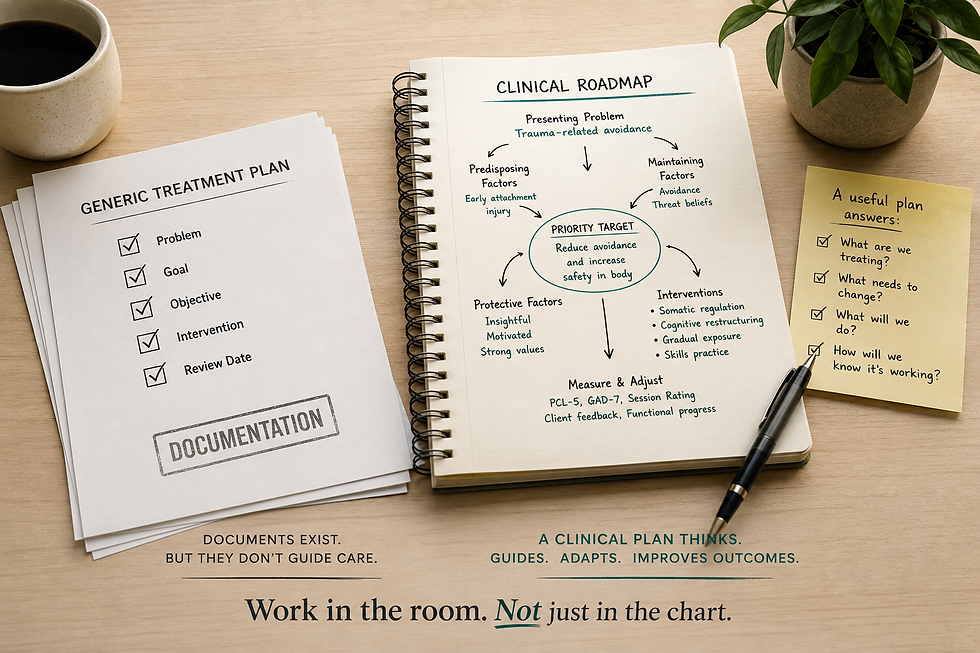
Historically, we have relied heavily on documentation to demonstrate that care occurred and clinical judgment to explain why it should continue. Those are important, but they are not synonymous with quality.
As financial pressure on healthcare increases, I expect that distinction to matter more.
MEASUREMENT-BASED CARE IS PART OF THE ANSWER, NOT THE WHOLE ANSWER
Measurement-based care has been one of the most promising developments in addressing this problem. Repeated use of validated measures gives clinicians information that can be examined over time rather than relying entirely on impressions formed during individual appointments.
The evidence supporting MBC has continued to grow, and organizations including CMS and NCQA have increasingly incorporated patient-reported outcomes and behavioral health measurement into broader quality efforts.
Still, there is a substantial difference between administering measures and building a healthcare system that knows what to do with the information they produce.
Behavioral health has no shortage of screening instruments, symptom measures, diagnostic tools, and outcome measures. We have become increasingly capable of generating data.
The harder question is whether generating more data necessarily produces better care.
A clinician can administer an assessment every month and remain ineffective. An organization can report outcome measures and still have poor clinical practices. A payer can possess enormous quantities of claims and utilization data without knowing whether an individual patient received good psychotherapy.
Measurement gives us visibility. It does not automatically give us meaning.
AI MAKES THIS MUCH MORE INTERESTING
Artificial intelligence introduces another layer entirely.
Healthcare organizations are already exploring AI for documentation, administrative efficiency, clinical decision support, quality measurement, data analysis, and numerous other applications. HHS has established an agency-wide AI strategy, and CMS continues to expand its work involving digital quality measurement and emerging technologies.
Behavioral healthcare will inevitably participate in this transition. The possibilities are substantial. So are the limitations. AI is extraordinarily good at processing information. That does not mean the information being processed is necessarily good.
Behavioral health contains decades of clinical records written within a system that tolerates considerable variation in terminology, treatment planning, diagnostic practices, documentation, outcome measurement, and definitions of progress. Giving increasingly sophisticated technology access to increasingly large quantities of information does not resolve those inconsistencies.
In some ways, AI may simply make them easier to see. That is why I think the more important conversation is not whether AI will replace therapists. That question gets attention because it is provocative, but it misses a more immediate issue.
What happens when healthcare becomes capable of examining behavioral health data at a scale we have never experienced before?
We may discover that our greatest limitation was never our ability to process the information. It was our ability to agree on what constituted meaningful information in the first place.
THEN THERE IS UTILIZATION
Utilization is another area where behavioral health presents a peculiar challenge.
Counting services is straightforward. Determining whether the amount of care was clinically appropriate is considerably more complicated.
A patient receiving six months of psychotherapy may be receiving exactly the care that is needed. Another patient receiving the same number of sessions may have achieved the original treatment goals months earlier. A third may not be improving at all and may require a different intervention.
The number of sessions does not answer the clinical question.
At the same time, simply invoking individualized care cannot be the entire answer either. If there are no meaningful standards by which treatment can be examined, then almost any duration, frequency, or course of psychotherapy can be defended after the fact. That leaves payers, organizations, clinicians, and patients in an uncomfortable position.
Everyone has a legitimate interest in appropriate care, but the industry has not always been particularly good at defining what evidence of appropriate care should look like.
Arbitrary limits are a poor answer to that problem.
Unlimited subjectivity is not a particularly good one either.
THE TENSION WE NEED TO SOLVE
I think this is where the next stage of behavioral healthcare becomes interesting.
We need greater objectivity without pretending human beings can be reduced to an algorithm. We need better accountability without allowing reimbursement rules to dictate psychotherapy. We need clinicians to retain professional judgment while accepting that professional judgment should be defensible. We need measurement without confusing the existence of a score with the existence of good treatment. And we need to determine what role AI should play before technological capability begins making that decision for us.
None of these problems is particularly simple.
They are also increasingly difficult to separate from one another.
My own thinking about them has changed considerably over the past year, partly because of what I have learned from building and using the Untangled Mind™ Assessment Engine and partly because of conversations with other clinicians who have been using it.
Recently, I had one of those conversations with a former professor of mine who has used the Engine since its launch. We spent time discussing what it does now, what he has experienced using it, and where I believe behavioral healthcare is heading. When I explained what I have been thinking about next, his enthusiasm reinforced my own. The original Assessment Engine was built to address a problem I saw in clinical practice.
The questions I am asking now are larger.
How will behavioral healthcare demonstrate quality in a changing reimbursement environment? How do we preserve clinical judgment while increasing objectivity? What happens when AI becomes capable of examining clinical information at scale? How should we think about utilization when neither arbitrary limits nor unlimited subjectivity adequately solves the problem? And what should a modern behavioral health system be capable of telling us about the care being delivered?
I don't have any interest in building technology simply because healthcare has decided it needs more technology. I am interested in building systems that answer problems worth solving.
Those questions are shaping the next evolution of the Untangled Mind™ Assessment Engine. V3 is underway.
SOURCES & FURTHER READING
Centers for Medicare & Medicaid Services — Behavioral Health Strategy
Centers for Medicare & Medicaid Services — National Quality Strategy
National Committee for Quality Assurance — Measurement-Based Care in Behavioral Health
— Artificial Intelligence Strategy


Comments