How to Use Measurement-Based Care Without Turning Therapy Into a Spreadsheet


One objection to measurement-based care is understandable:
I didn't become a therapist to stare at numbers.
Good. Don't.
The goal of measurement-based care isn't to replace psychotherapy with metrics. It's to give psychotherapy another source of clinical information.
Measure What Matters
More assessment isn't automatically better assessment. Choose measures because they answer a clinical question. If you're treating posttraumatic symptoms, monitor the relevant trauma symptoms. If anxiety is the primary target, measure anxiety. If dissociation appears clinically significant, assess it appropriately. The assessment battery should serve the case. The case shouldn't serve the assessment battery.
Establish a Baseline
Initial measurement helps establish where treatment began. Without a baseline, later statements about improvement depend heavily on memory and impression. Both matter. Neither is particularly precise. A baseline gives clinician and client another reference point.
Don't Discuss Every Number
Measurement shouldn't consume the session. A clinician can review the results before or during the appointment and identify what actually warrants attention. A significant improvement? Mention it. Unexpected deterioration? Definitely mention it. A discrepancy between the score and the client's experience? Explore it. Nothing clinically meaningful changed? You probably don't need a 20-minute conversation about the graph.
Use the Information
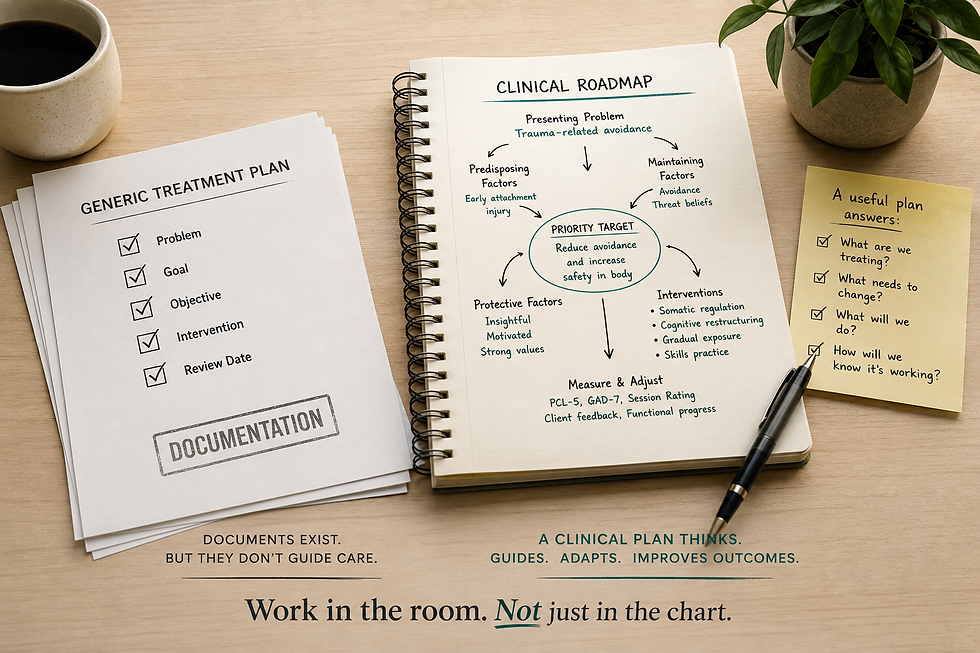
This is the part that matters. If the measure shows improvement, ask whether the improvement is consistent with functioning and client report. If it shows deterioration, investigate. If nothing changes despite adequate treatment exposure, reconsider. The data creates a prompt for clinical reasoning.
Keep Judgment in the Room
A measure cannot know that the client's mother died last week. It cannot observe the client's behavior, it cannot understand why a score changed, it cannot determine whether a statistically meaningful change is personally meaningful. That's why clinicians still have jobs.
The measure contributes information. The clinician and client determine what it means.
Measurement-based care should make treatment more responsive. Not more mechanical.


Comments