Why Treatment Plans Become Documentation Instead of Clinical Tools

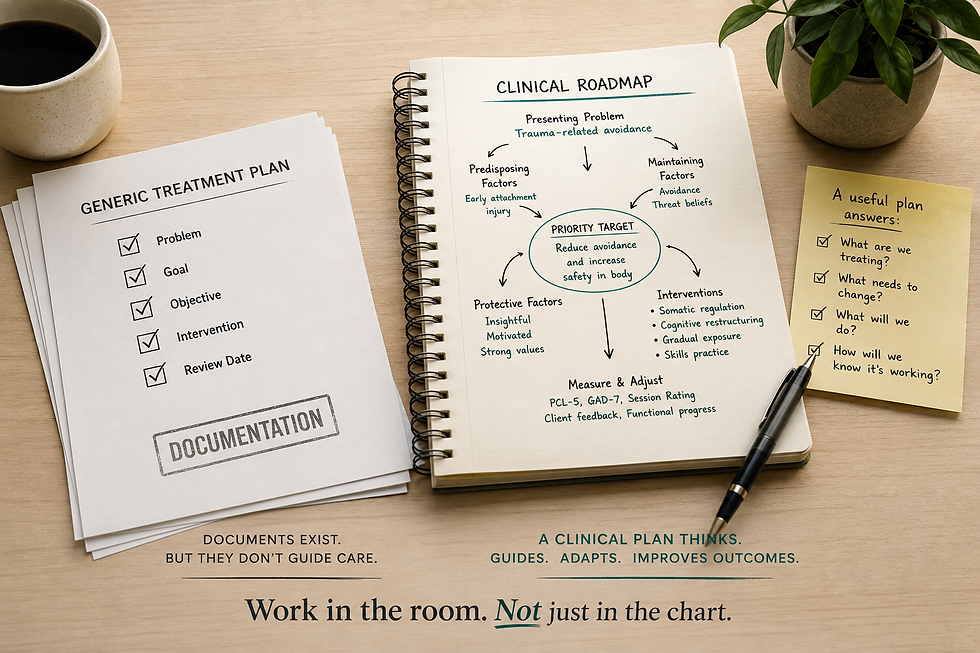
Ask a clinician about their treatment plan and you may get one of two answers. The actual conceptual plan they carry in their head. And the treatment plan sitting in the chart. Those should probably be the same thing. Too often, they aren't.
The Documentation Problem
Treatment plans are frequently built to satisfy documentation requirements.
Problem.
Goal.
Objective.
Intervention.
Click.
Save.
Return in 90 days.
The documentation exists. But if it isn't meaningfully influencing what happens in the therapy room, it isn't doing much clinical work.
A Treatment Plan Should Answer Basic Questions
A useful plan should make it possible to answer:
What is the problem?
What needs to change?
What are we doing to change it?
How will we know whether it worked?
Those questions sound obvious. They're also surprisingly easy to lose beneath templated language. “Client will improve coping skills.” How? For what? What is the skill supposed to change? How would we recognize improvement?
Make the Target Observable
The more precisely we define the target, the easier it becomes to select an intervention and evaluate its effect.
Instead of:
Decrease anxiety.
Consider:
Reduce behavioral avoidance associated with feared social evaluation.
Now treatment can address something identifiable. And measurement can evaluate something meaningful.
Treatment Plans Should Change
The initial treatment plan is based on the best information available at the beginning of care. That information is incomplete. As treatment progresses, we learn more. Some hypotheses are confirmed. Others aren't. Priorities change. Symptoms improve. New barriers become visible. The treatment plan should respond accordingly. A plan that remains unchanged despite meaningful clinical information isn't structure.
It's paperwork.
Documentation Should Follow Clinical Reasoning
The solution isn't more elaborate treatment plans. It's making the documented plan reflect the clinician's actual reasoning.
A treatment plan should be useful in the therapy room before it is useful in an audit. Learn how to use the Assessment Engine to bridge this gap in treatment planning.


Comments