Assessment Scores Aren't a Treatment Plan


A client scores 17 on an anxiety measure. Severe. We now know something we didn't know before. We still don't have a treatment plan.
One of the most important distinctions in measurement-based care is the difference between describing the clinical picture and deciding what to do about it. Assessment instruments are very good at the first. Treatment requires the second.
Severity Is Important
Severity classifications provide clinicians with standardized reference points. They can help establish baseline symptom burden, identify potential areas requiring further assessment, support ongoing monitoring, and provide another source of information alongside interview and observation. None of that is trivial. The problem occurs when the severity label becomes the end of the reasoning process.
Severe anxiety → treat anxiety isn't much of a clinical formulation.
What's Producing the Score?
A useful treatment plan requires us to get underneath the total. Suppose a client's anxiety score is substantially elevated. What accounts for that elevation? Persistent worry? Avoidance? Panic symptoms? Trauma-related hyperarousal? Reassurance seeking? Sleep disruption? Somatic vigilance? Intolerance of uncertainty? Several of them?
The answer begins moving us from a measurement toward a problem formulation.
From Problem to Target
The next step is determining what is changeable. “Anxiety” is a presenting problem.
It isn't necessarily a useful treatment target. A treatment target needs to tell us more specifically what we're trying to change.
Reduce avoidance.
Increase tolerance of physiological arousal.
Interrupt reassurance-seeking behavior.
Improve discrimination between present threat and trauma cues.
Increase behavioral engagement despite uncertainty.
Now we're getting somewhere. Because identifiable targets allow us to choose interventions for a reason.
Intervention Should Follow Formulation
This sequence matters:
Assessment → Interpretation → Formulation → Target → Intervention
When we skip the middle, treatment selection can become surprisingly arbitrary. The client has trauma, so we do EMDR. The client has anxiety, so we teach breathing. The client has depression, so we recommend behavioral activation. Each intervention may be appropriate. The question is why it is appropriate for this person, at this point in treatment, for this particular target. That's clinical reasoning.
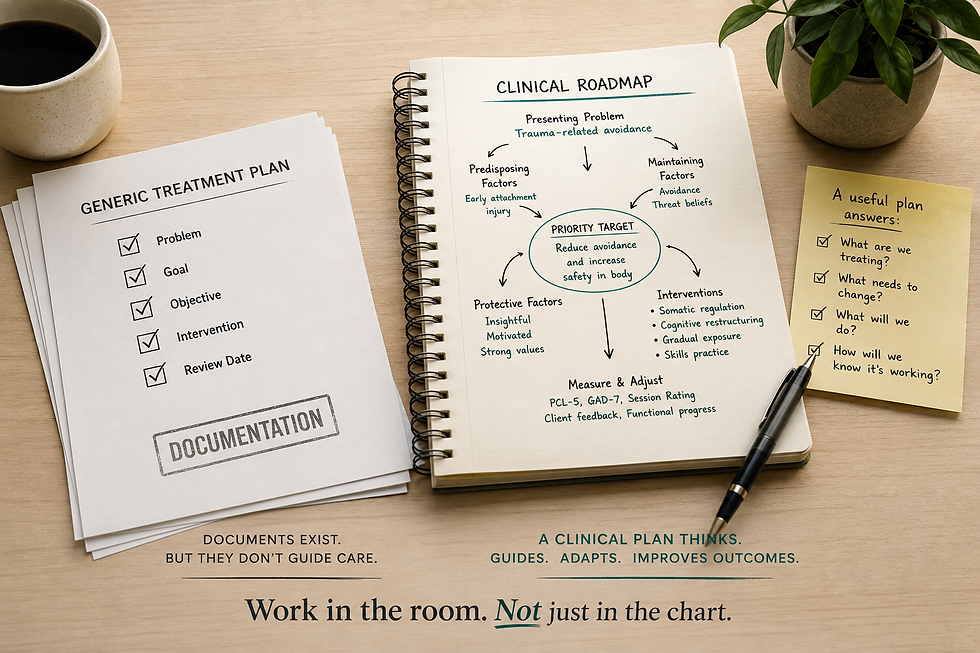
Treatment Planning Should Be a Clinical Tool
A treatment plan shouldn't exist primarily because the chart requires one.
It should tell us:
What are we treating?
What appears to be maintaining it?
What are we targeting?
What are we doing about it?
How will we know whether it's changing?
Assessment data can contribute significantly to that process. But the score is not the plan. Good measurement gives us better information. Good clinical reasoning turns that information into treatment.


Comments