Measurement-Based Care Is More Than Sending a PHQ-9


The questionnaire went out automatically. The client completed it before the appointment. The score landed in the chart. Technically, we measured something. That doesn't necessarily mean we're practicing measurement-based care. The distinction matters because measurement-based care isn't defined by collecting data. It's defined by what happens because of the data.
Measurement Is the First Step
Validated clinical measures give us information that clinical conversation alone may not provide as consistently.
They can help clinicians:
establish baseline symptom severity;
identify areas requiring additional assessment;
monitor change over time;
detect deterioration or lack of expected progress;
and create a shared reference point for discussing treatment.
But none of those benefits occur automatically because a questionnaire exists in the EHR.
Someone has to use the information.
The Missing Step Is Clinical Integration
Suppose a client's score has remained essentially unchanged across three measurement periods. What happens next? Nothing? Continue the same treatment because the sessions seem productive? Or ask why the expected change isn't occurring?
Measurement-based care creates a feedback loop:
Measure → Interpret → Discuss → Decide → Intervene → Reassess
The reassessment isn't an administrative endpoint. It feeds directly back into clinical reasoning.
Data Doesn't Replace the Client
There is an understandable concern that measurement can make psychotherapy mechanical. Used poorly, it can. Used well, it does the opposite. A score should never supersede the client's report, clinician observation, context, functional change, or clinical judgment. It gives us another piece of information to examine alongside them.
A client may report substantial improvement while a symptom measure changes very little. That's worth exploring.
A score may improve substantially while the client reports that their life hasn't.
That's also worth exploring.
Neither the number nor the narrative automatically wins. The discrepancy itself is clinical information.
Measurement Creates Accountability
One of the uncomfortable advantages of measurement is that it makes lack of progress harder to ignore. That is precisely why it is useful. If treatment isn't producing the expected change, we should be willing to examine:
the formulation,
the treatment target,
the intervention,
the therapeutic relationship,
client engagement,
external barriers,
or whether another type or level of care is needed.
Continuing indefinitely because therapy feels productive isn't the same as demonstrating that treatment is accomplishing its purpose.
The Point Isn't More Data
Behavioral healthcare already generates enormous amounts of information.
We don't necessarily need more. We need to make better use of what we're collecting.
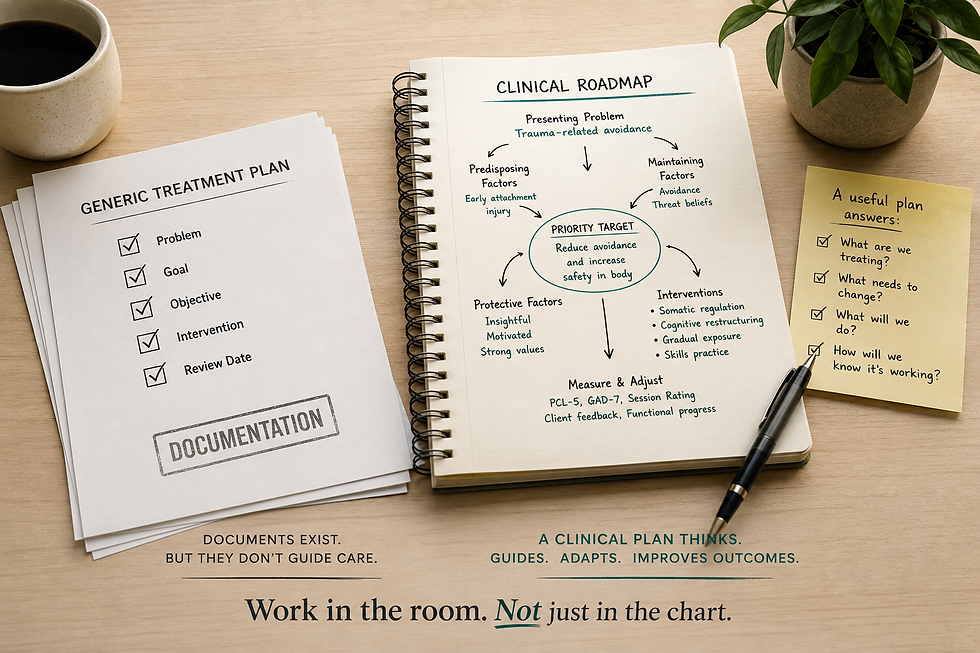
Measurement-based care begins when the result has the potential to change the care. Explore Measurement Based Care


Comments