Clinical Formulation vs. Diagnosis: Why Clinicians Need Both


A diagnosis and a clinical formulation answer different questions.
Diagnosis asks: What condition best describes this presentation?
Formulation asks: What appears to be happening with this person, why is it happening, and what are we going to do about it?
We need both.
Diagnosis Organizes the Clinical Picture
Diagnosis provides a common professional language. It can organize symptom patterns, support communication among providers, inform treatment considerations, and establish medical necessity when insurance is involved. But two people meeting criteria for the same diagnosis can arrive in our offices with remarkably different histories, maintaining factors, functional impairments, strengths, and treatment needs. The diagnostic label cannot contain all of that information. It isn't supposed to.
Formulation Makes It Individual
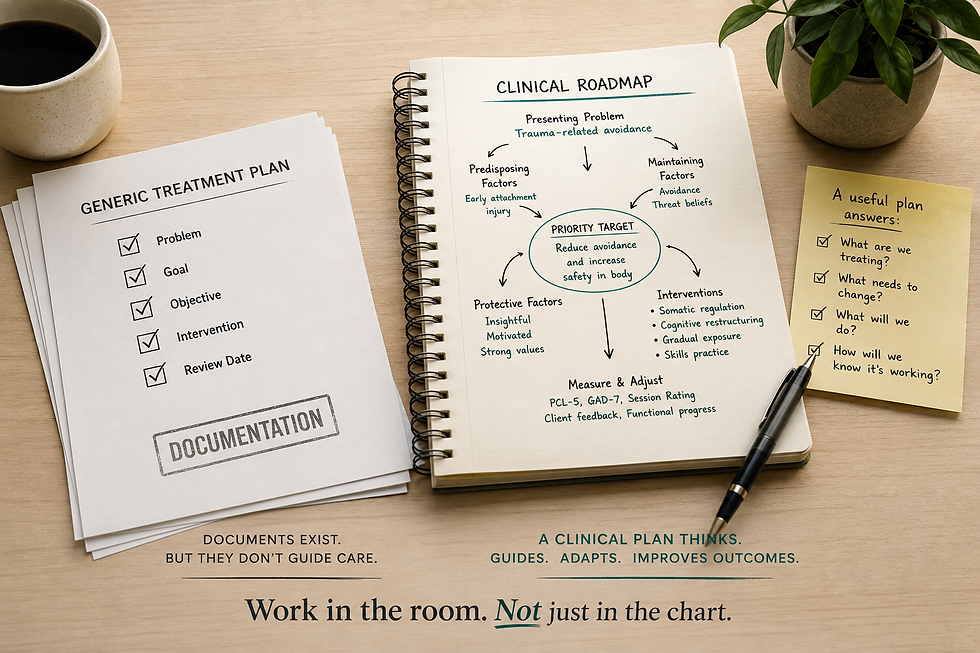
Clinical formulation takes the available information and organizes it into a working explanation. Depending on the clinician's theoretical orientation, that may include:
predisposing factors,
precipitating events,
maintaining processes,
protective factors,
cognitive patterns,
behavioral responses,
physiological processes,
attachment dynamics,
environmental conditions,
and functional consequences.
The purpose isn't to produce an impressive paragraph. The purpose is to make treatment more precise.
Formulation Should Lead Somewhere
A formulation that doesn't influence treatment is merely descriptive. If I believe avoidance is maintaining a client's anxiety, that should affect the treatment plan. If trauma-related threat discrimination is central to the presentation, that should affect intervention selection. If physiological arousal repeatedly precedes cognitive escalation, that may affect sequencing. If interpersonal reinforcement maintains a behavioral pattern, insight alone may not be enough.
The formulation creates the bridge between what we're observing and what we're doing.
And It Should Remain Revisable
A formulation is a working clinical hypothesis. New information may change it. Treatment response may change it. Assessment data may challenge it. The client may challenge it. Good.
Clinical formulation shouldn't become something we're obligated to defend.
It should become something we're willing to test.
Diagnosis helps us name the clinical problem. Formulation helps us decide what to do next. Explore Professional and Clinical Training


Comments